Top 10 Tips On How To Establish The Frequency Of Testing For PAT in Rugby
Determine the correct frequency of Portable Appliance Testing (PAT). This is one of the biggest challenges that dutyholders face under UK health and Safety law. Contrary to widespread misconception, there is no mandated statutory interval–such as an annual requirement–specified in the Electricity at Work Regulations 1989. Regulation 4(2) sets out a general duty for electrical systems to be maintained to prevent harm. The legal burden is on the employer, or person responsible, to develop a maintenance plan through a structured evaluation of risks. The Health and Safety Executive strongly endorses this risk-based approach. It moves away from blanket test schedules and demands a documented, reasoned justification for all testing and inspection intervals. The frequency must be proactively determined by evaluating the type of equipment, its operating environment, its users, and its previous history, making PAT scheduling a dynamic process rather than a passive, calendar-based compliance exercise.
1. The Absolute Primacy of Risk Assessment
The frequency for testing is not dictated by law. However, the dutyholder must conduct a sufficient and appropriate risk assessment. This is the document that will support your PAT testing program. This assessment must take into account all the factors that can cause an appliance become dangerous, and determine how often they should be tested and/or inspected to reduce that risk. The HSE inspector will be expecting to see the assessment and will then judge the frequency of testing against the conclusions. It is essential to any testing schedule. Without it, the schedule will be arbitrary and non-compliant.
2. Key Factors Influencing Testing Intervals
For a reasonable frequency of testing, a risk assessment will evaluate several core elements. These include: Equipment Type: Class I appliances (e.g., kettles, toasters, power tools) require more frequent testing than Class II (double-insulated) appliances due to their earth reliance. Environment: A harsher environment (such as on a building site, in a workshop, or in a commercial cooking area) calls for more frequent checks. Users: If the equipment is being used by a trained employee, it may need to be tested less frequently than if it's being used by a public or untrained personnel. Appliance construction: More robust equipment is less likely to be a risk. Previous History: An appliance with a record of faults will require more frequent checking.
3. Formal visual inspections: Their critical role
Formal visual checks are part of a maintenance regime that is legally valid and often more important than combining inspections and tests. They can detect the majority of faults such as cable damage and loose plugs. A formal visual inspection performed by a qualified person in a low-risk environment (such as a desktop PC in an office) may be sufficient for many appliances. Routine electronic testing is not required. The risk assessment will also determine the frequency of formal visual inspections.
4. Checking the User and First Line Maintenance
Before any formal process, user checks form the first line of defence. The dutyholder is responsible for encouraging users to do a visual pre-use check, including looking out for signs of damage like frayed cables, burned marks, or loose components. Promoting a culture that encourages user awareness may not be recorded in a formal PAT system but is still an important component of a holistic, risk-based approach. This can help identify potential problems between scheduled official inspections.
5. Code of Practice of IET – Guidance
It is important to note that the IET Code of Practice does not constitute law. However, it offers valuable guidance as to recommended first frequencies. The table offers intervals for various types of equipment in different environments. This table provides a solid starting point to assess risk for dutyholders. It might, for example, suggest that equipment on a building site be visually inspected every three months but IT equipment in a office is inspected at intervals of 24 months. These recommendations are preliminary and will be modified according to actual experience.
6. The Concept of Result-Based Frequency Scheduling
In order to be truly sophisticated and compliant, future testing frequency should be adjusted based on previous results. If an appliance, or a category of appliances, consistently passes its tests without fault over several years, the risk assessment can be reviewed to justify extending the testing interval. If an appliance or a category of appliances fails its tests frequently, it is better to shorten the testing interval. The enforcement authorities are very supportive of this dynamic and evidence-based approach.
7. New Appliances & Equipment
The common belief is that testing new equipment is not necessary. It may not require a formal combined testing before the first use but a visual inspection will still be required to check the equipment for transit damage, the correct wiring of the plug and its suitability for the UK (e.g. a properly fused plug). The risk evaluation will determine the date of the first test for new equipment.
8. Hired or Borrowed Equipment
PAT must be used for equipment that is brought on site, like hired tools or contractors' equipment. It's the dutyholder who has to check that the equipment will be safe before it is used. Such equipment is usually subject to conservative risk assessments, which require an inspection and testing immediately before the first use.
9. Documenting the rationale for selected frequencies
Documentation is used to demonstrate compliance. The risk assessment document must include both the frequency and the rationale for the choice of appliance. This document is proof of "due due diligence." This document should list the factors to be considered (environment type, user, and equipment type), as well as, if appropriate, reference the IET Code of Practice.
10. Regular Review and Adjustment of Intervals
The risk assessment and testing frequency it specifies are not static documents. Regulation 4 of Electricity at Work Regulations 1988 requires continuous maintenance. The dutyholder shall review the testing intervals and risk assessment on a periodic basis (e.g. every year) or in response to any significant change. The system will remain effective and proportionate. Read the best Rugby fixed electrical testing for blog advice.

Top 10 Tips For Regulatory Compliance When Servicing Fire Extinguishers in Rugby
The UK regulatory framework that regulates fire extinguisher services is a complete, clearly defined system. It includes clearly defined legal requirements and standards along with certification programs. The regulations for fire extinguishers are more specific than other safety regulations, which provide general guidelines. They are supported by specific technical standards, as well as third-party certification programs that create a logical way to ensure compliance. The "Responsible Individual" is the sole person accountable for the upkeep of each building, but there are guidelines and benchmarks to demonstrate due diligence. Knowing this framework will assist you in maintaining legal compliance and make sure that your fire safety equipment functions properly in an emergency.
1. The Regulation Reform (Fire Safety) Order 2005 (FSO) in Rugby
The Fire Scotland Act 2006 and Northern Ireland have similar regulations. Article 17 specifically mandates that all equipment for fighting fires be "subject to a maintenance system and maintained in a state of efficiency and in good working order and in good condition." This Order imposes this responsibility to the "Responsible Party" (typically the owner or employer of the premises) and makes them legally responsible.
2. British Standard BS 5306-3 : 2017
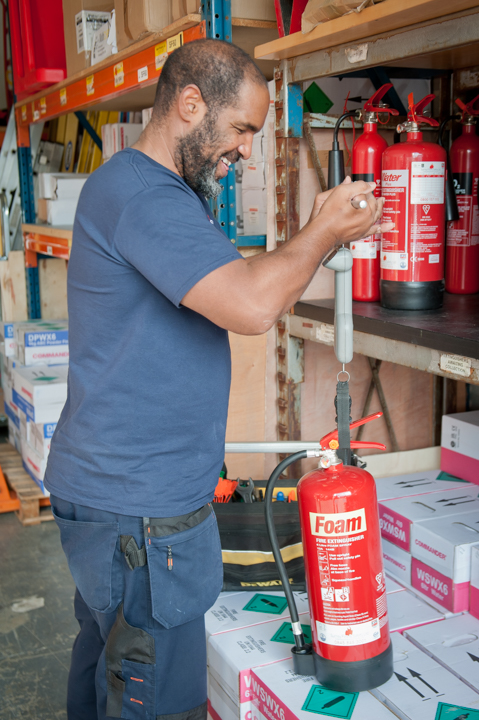
This standard provides an technical framework that is in line with the FSO. It outlines the specific requirements for the commissioning and maintenance of portable extinguishers. It provides different types of service which include the basic type (annual inspection and simple tests) and extended service (5-year discharge test and an internal examination for water extinguishers as well as extinguishers with foam or powder) and overhaul (10-year pressure test and examination for CO2 extinguishers). In order to meet the legal requirements, the compliance with BS 5306-3 must be proven.
3. Third-Party Certificated Schemes in Rugby
While not legally required, the presence of a BAFE (British approvals for fire equipment) SP101 certified offers the most impressive evidence of due diligence. This UKAS accreditation scheme verifies independent of a company's compliance with strict standards for technician competence, work-quality, equipment and business procedures. Insurance companies, fire authorities and courts acknowledge BAFE certification as evidence of compliance with FSO's requirements for maintenance, significantly strengthening the Responsible person's legal status.
4. The Role of the Fire Risk Assessment in Rugby
Fire Risk Assessment is a dynamic document which drives every decisions regarding fire safety and extinguishers. The Fire Risk Assessment (FRA) must specify the nature, size and Rugby of firefighting equipment as well as the requirements for its maintenance. The FRA is required to be re-examined regularly, especially if circumstances change, and any changes should be noted in the servicing schedule. Reports from the servicing provider can be helpful for these reviews.
5. Documentation and proof is a requirement. in Rugby
To ensure compliance, it's important to have comprehensive documentation. After each service, the company should issue a report with the company's details including engineer's details as well as service dates, a details of equipment, service type performed and any identified flaws. These documents must always be accessible for inspection by the authority that enforces (Fire and Rescue Services), and insurers. In the absence of adequate documentation could result in an enforcement action, even if the service was actually carried out.
6. Enforcement Mechanisms, Penalties and Other Methods of Enforcement, Penalties and Other in Rugby
Local Fire and Rescue Authorities have vast enforcement powers and conduct audits of compliance. In cases of non-compliance to the requirements for servicing, local Fire and Rescue Authorities are able to issue Amendment Notices that demand specific actions within a specified time frame Enforcement Notices that require specific improvements or, in the event that the situation is extremely serious, Prohibition Warnings which immediately limit or shut down the facility. In the case of serious violations of the law, which includes ones that could endanger life, the court may issue unlimited penalties.
7. The Impact of Insurance in Rugby
A majority of commercial insurance policies require compliance with fire safety legislation in the policy's terms of. Insurance coverage can be invalidated due to inadequate servicing records or incompliant providers following a major fire. Insurance assessors require servicing records in the course of processing claims. Insurers can also demand specific standards for certification, such as BAFE Sp101, as an essential requirement for insurance coverage, especially in large commercial buildings and in high-risk properties. policies.
8. Minimum Technical Competency Requirements for Technicians in Rugby
The FSO demands that maintenance is carried out by a qualified person. While not legally defined, competence generally includes: formal training on BS 5306-3, manufacturer-specific equipment training, practical experience, and understanding of relevant regulations. Through regular tests and audits, third-party certificate schemes like BAFE SP101 verify technician competence.
9. Environmental Compliance in Rugby
Environmental protection legislation is responsible for the disposal of waste and decommissioned extinguishers. The Environmental Protection Act, 1990 is the primary environmental law. Service providers must be registered waste transporters and issue Waste Transfer Notes (WTNs) for the equipment that is to be removed. The responsible person must ensure sure that the company disposes of their waste in a legal manner. They ultimately are responsible for the disposal of their waste and could be fined for not following the rules.
10. The frequency and scope of service requirements in Rugby
In order to be in compliance, BS 533-3 service frequencies must be strictly adhered to. They include the basic service every year for all extinguishers, extended service every 5 years for extinguishers constructed of water, powder or foam, and overhauls once every 10 years for units that utilize CO2. Moreover, the Responsible Person must ensure that the monthly inspections are performed by personnel (often). These checks must be conducted to spot obvious problems such as obstruction, damage or loss of pressure. The combination of professional servicing with user checks creates an efficient maintenance plan. Follow the most popular Rugby fire extinguisher maintenance for site info.